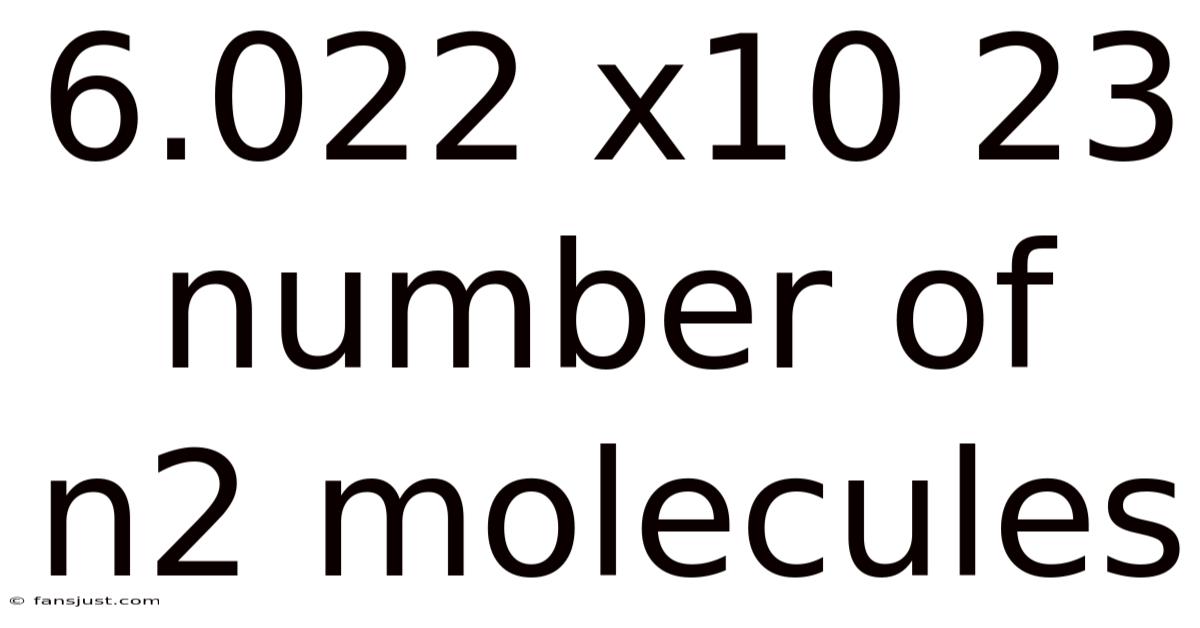
The Remarkable 6.022 × 10^23: Understanding the Number of N2 Molecules
The 6.022 × 10^23 number of N2 molecules represents one of the most fundamental concepts in chemistry and physics, serving as a bridge between the microscopic world of atoms and the macroscopic world we experience daily. This extraordinary number, known as Avogadro's number, provides a standardized way to count particles in a mole, a unit essential for chemical calculations and scientific research. When we talk about 6.022 × 10^23 molecules of N2, we're not just dealing with a large quantity—we're looking at a scale that defies human intuition and reveals the profound interconnectedness of matter at different levels.
What is Avogadro's Number?
Avogadro's number, approximately 6.022 × 10^23, is a fundamental constant in chemistry that defines the size of a mole. A mole is a unit of measurement that represents the number of particles—atoms, molecules, ions, electrons, or other entities—contained in a given substance. This number was named after the Italian scientist Amedeo Avogadro, who proposed that equal volumes of gases at the same temperature and pressure contain equal numbers of molecules. Plus, in practical terms, one mole of any substance contains exactly 6. 022 × 10^23 particles. For nitrogen gas (N2), which is the primary component of Earth's atmosphere, this means that a single mole of N2 molecules contains 6.022 × 10^23 N2 molecules.
Understanding this concept is crucial because it allows chemists to convert between the macroscopic world (what we can see and measure) and the microscopic world (where atoms and molecules interact). Without Avogadro's number, precise chemical calculations would be nearly impossible, as it provides the essential link between the atomic scale and the measurable scale of laboratory experiments Less friction, more output..
The Significance of N2 Molecules in Our World
Nitrogen (N) is the second most abundant element in the Earth's atmosphere, making up about 78% of the air we breathe. While N2 is an inert gas at room temperature, it plays a vital role in biological processes, including the synthesis of amino acids, proteins, and nucleic acids—the building blocks of life. The sheer number of N2 molecules in our atmosphere—approximately 6.Practically speaking, as a diatomic molecule (N2), nitrogen consists of two nitrogen atoms bonded together. 022 × 10^24 molecules per cubic meter at standard conditions—highlights the immense scale of chemical systems we interact with daily.
Consider the air around you. Every breath you take contains billions upon billions of nitrogen molecules. Even so, when you breathe, you're inhaling a mixture of gases, but nitrogen dominates at about 78% concentration. Think about it: if you could somehow count every single N2 molecule in the volume of air you've just inhaled, you would be counting on the order of 10^28 molecules. This staggering figure underscores why chemistry must use standardized units like the mole to make sense of such vast quantities.
Counterintuitive, but true.
How Many N2 Molecules Are in a Mole of Nitrogen?
The calculation is straightforward once you understand the relationship between moles and particles. One mole of any substance contains exactly 6.022 × 10^23 particles. Because of this, one mole of N2 molecules contains 6.022 × 10^23 N2 molecules. So in practice, if you have 1 gram of nitrogen gas (since the molar mass of N2 is approximately 28 grams per mole), you would have exactly 6.022 × 10^23 N2 molecules. This consistency across different elements and compounds is one of the most powerful tools in chemistry, allowing scientists to predict reaction yields, balance chemical equations, and understand material properties Still holds up..
To put this in perspective, let's compare the number of N2 molecules in different quantities. In practice, a single molecule of N2 has a mass of about 28 atomic mass units (amu). A mole contains 6.Now, 022 × 10^23 such molecules, resulting in a total mass of approximately 28 grams. So while a single N2 molecule weighs only a tiny fraction of an atom, multiplying this by Avogadro's number gives us a quantity that dwarfs the number of stars in the observable universe Worth keeping that in mind. Less friction, more output..
Calculating the Number of N2 Molecules in Everyday Objects
While it's difficult to count individual molecules in everyday objects, we can estimate the number of N2 molecules in common items using the mole concept. Take this: a standard balloon filled with air contains roughly 1 mole of gas molecules. Since nitrogen makes up 78% of the air, a balloon would contain approximately 0.In real terms, 78 moles of N2 molecules, or about 4. Which means 7 × 10^23 N2 molecules. Still, similarly, a liter of air contains about 2. 7 × 10^25 N2 molecules at room temperature and pressure.
Even more impressive is the number of N2 molecules in a single grain of rice. A typical grain of rice weighs about 20 milligrams. Since the molar mass of N2 is 28 g/mol, a 20 mg sample contains roughly 0.0007 moles of N2 molecules, which translates to approximately 4.2 × 10^20 N2 molecules. This demonstrates how the mole concept scales from the atomic level to everyday objects, providing a consistent framework for understanding chemical composition across all magnitudes The details matter here. Nothing fancy..
The Importance of Understanding N2 Molecule Count
Understanding the number of N2 molecules is not merely an academic exercise—it has practical implications in numerous fields. Still, in industrial chemistry, precise knowledge of particle counts allows for the optimization of chemical reactions, ensuring that processes like ammonia synthesis (Haber process) or polymerization yield the desired products efficiently. In environmental science, knowing the number of N2 molecules in atmospheric samples helps scientists study nitrogen cycles, pollution levels, and the effects of climate change on atmospheric composition.
For students learning chemistry, grasping Avogadro's number and its application to N2 molecules is a key milestone. It transforms abstract concepts into tangible reality, showing how the microscopic world connects to the macroscopic world. This understanding is essential for fields ranging from ph
...physical chemistry to pharmacology, where precise molecular interactions dictate drug efficacy and molecular design.
Beyond these established domains, the implications stretch into the cutting edge of biotechnology. In genetic research, the delivery of nitrogen-containing nucleotides into cells relies on understanding the kinetics of molecular collisions, which are influenced by particle density. Similarly, in cryogenics, the behavior of nitrogen gas in its liquid or solid state is critical for preserving biological samples, requiring precise knowledge of how many molecules are present to maintain
maintaining the structural integrity of biological specimens during long-term storage. This detailed interplay between scale and function highlights why the mole concept remains a cornerstone of modern science. At the end of the day, mastering the concept of the mole allows scientists and engineers to translate abstract formulas into measurable realities. Whether optimizing industrial yields or developing life-saving pharmaceuticals, the ability to quantify the invisible world of molecules is indispensable. As technology advances, the precision of our counting methods will only grow, revealing deeper insights into the natural world.
At the end of the day, mastering the concept of the mole allows scientists and engineers to translate abstract formulas into measurable realities, bridging the gap between theoretical chemistry and practical application. In real terms, as our tools for measurement and simulation become more sophisticated, the mole concept will continue to serve as the essential link in translating the behavior of individual particles into the predictable outcomes of bulk matter. Whether in the synthesis of life-saving drugs or the preservation of genetic material, the precision afforded by understanding particle counts is not just a theoretical benefit but a practical necessity. Practically speaking, the journey from a single N2 molecule to the vast quantities used in industry underscores a fundamental truth of the physical sciences: scale is relative, yet the underlying laws remain constant. By fostering this understanding, we empower future generations to innovate responsibly and sustainably, ensuring that the invisible dance of molecules drives the tangible advancements of tomorrow.
