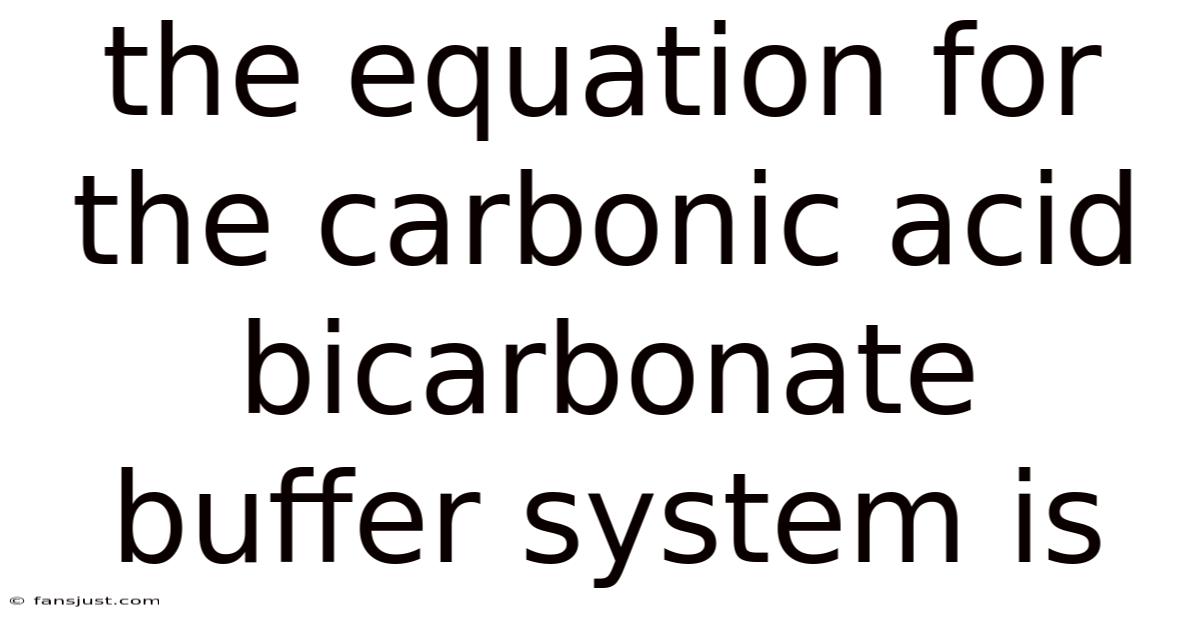
The carbonic acid bicarbonate buffer system stands as the most critical physiological buffer in the human body, responsible for maintaining the delicate acid-base balance required for life. Governed by a reversible chemical equilibrium, this system operates primarily in the blood plasma, interstitial fluid, and renal tubules, effectively neutralizing metabolic and respiratory acids to keep arterial pH within the narrow, life-sustaining range of 7.35 to 7.45. Understanding the equation that drives this mechanism provides the foundation for clinical medicine, physiology, and biochemistry That's the whole idea..
The Core Chemical Equation
At the heart of the system lies a two-step reversible reaction sequence. The overall net equation is typically represented as:
CO₂ + H₂O ⇌ H₂CO₃ ⇌ H⁺ + HCO₃⁻
This deceptively simple formula encapsulates a dynamic interplay between dissolved carbon dioxide, carbonic acid, hydrogen ions, and bicarbonate ions. To fully grasp its physiological power, one must dissect each component and the distinct phases of the reaction.
Phase 1: Hydration of Carbon Dioxide
The reaction begins when carbon dioxide (CO₂), a waste product of cellular respiration, diffuses into the blood plasma or red blood cells. Here, it combines with water (H₂O) to form carbonic acid (H₂CO₃).
CO₂ + H₂O ⇌ H₂CO₃
In plasma, this hydration reaction occurs slowly without assistance. On the flip side, inside red blood cells (erythrocytes), the enzyme carbonic anhydrase catalyzes this step, accelerating the reaction rate by roughly 10,000-fold. This enzymatic speed is essential; without it, CO₂ transport and pH buffering would be far too sluggish to match metabolic demand.
Phase 2: Dissociation of Carbonic Acid
Carbonic acid is a weak, unstable acid. It rapidly dissociates into a hydrogen ion (H⁺) and a bicarbonate ion (HCO₃⁻).
H₂CO₃ ⇌ H⁺ + HCO₃⁻
This dissociation is the actual "buffering" event. The generated hydrogen ions are the direct determinants of pH (pH = -log[H⁺]), while bicarbonate acts as the primary alkaline reserve.
The Henderson-Hasselbalch Equation: Quantifying the Balance
While the chemical equation describes what happens, the Henderson-Hasselbalch equation describes where the equilibrium sits. It is the mathematical tool clinicians use to calculate blood pH based on the ratio of the buffer pair components.
pH = pKa + log₁₀ ([HCO₃⁻] / [CO₂] × α)
Or, more commonly expressed in clinical settings using the partial pressure of CO₂ (PaCO₂):
pH = 6.1 + log₁₀ ([HCO₃⁻] / (0.03 × PaCO₂))
Breaking Down the Variables
- pH: The negative logarithm of hydrogen ion concentration. Normal arterial pH is 7.40.
- pKa (6.1): The negative logarithm of the apparent dissociation constant for the overall reaction (CO₂ + H₂O ⇌ H⁺ + HCO₃⁻) at 37°C. Note that the true pKa of carbonic acid (H₂CO₃ ⇌ H⁺ + HCO₃⁻) is ~3.6, but the apparent pKa incorporates the hydration equilibrium and the solubility of CO₂, making 6.1 the physiologically relevant constant.
- [HCO₃⁻]: The concentration of bicarbonate ions in mmol/L (mEq/L). Normal range: 22–26 mmol/L. This represents the metabolic component (regulated by kidneys).
- PaCO₂: The partial pressure of arterial carbon dioxide in mmHg. Normal range: 35–45 mmHg. This represents the respiratory component (regulated by lungs).
- 0.03 (α): The solubility coefficient of CO₂ in plasma at 37°C (mmol/L per mmHg).
This equation reveals a profound physiological truth: **pH is determined by the ratio of bicarbonate to dissolved CO₂, not their absolute concentrations alone.Day to day, ** A 20:1 ratio of [HCO₃⁻] to dissolved CO₂ yields a pH of 7. 40 Turns out it matters..
Physiological Regulation: The Organ Systems at Play
The elegance of the carbonic acid bicarbonate buffer system lies in its open nature. Unlike a closed chemical beaker, the body actively regulates both sides of the equation through two distinct organ systems.
Respiratory Regulation (The Denominator: PaCO₂)
The lungs control the volatile acid component (CO₂). Through alveolar ventilation, the body can rapidly adjust PaCO₂ And that's really what it comes down to..
- Hyperventilation blows off CO₂, lowering PaCO₂, shifting the equilibrium left (consuming H⁺), and raising pH (respiratory alkalosis).
- Hypoventilation retains CO₂, raising PaCO₂, shifting the equilibrium right (generating H⁺), and lowering pH (respiratory acidosis).
This response occurs within minutes, providing the first line of defense against pH disturbances.
Renal Regulation (The Numerator: [HCO₃⁻])
The kidneys control the fixed acid/base component (HCO₃⁻). This is a slower, more powerful, and sustained mechanism taking hours to days.
- Reabsorption: Proximal tubule cells reclaim filtered bicarbonate (roughly 4,320 mmol/day) to prevent its loss in urine.
- Generation: Intercalated cells in the collecting duct generate new bicarbonate by secreting H⁺ into the tubular lumen (buffered by phosphate and ammonia/ammonium) and adding HCO₃⁻ back to the blood.
- Excretion: In alkalosis, the kidneys can excrete bicarbonate directly into the urine.
The kidneys also handle the "non-volatile" acids (sulfuric, phosphoric, lactic, ketoacids) produced by metabolism. In real terms, these acids consume bicarbonate. The kidneys must regenerate this lost bicarbonate to maintain the buffer capacity.
The Critical Role of Hemoglobin and the Chloride Shift
The equation CO₂ + H₂O ⇌ H⁺ + HCO₃⁻ does not occur in isolation within the blood. Roughly 70% of CO₂ transport and buffering happens inside red blood cells (RBCs), facilitated by hemoglobin (Hb).
Hemoglobin as a Buffer
Deoxygenated hemoglobin (deoxy-Hb) is a better proton acceptor (weaker acid) than oxygenated hemoglobin (oxy-Hb). This is the Haldane Effect.
- In tissues: O₂ is released → Hb becomes deoxy-Hb → Deoxy-Hb binds H⁺ generated from carbonic acid dissociation → Frees up HCO₃⁻ to leave the RBC.
- In lungs: O₂ binds → Hb becomes oxy-Hb → Oxy-Hb releases H⁺ → H⁺ combines with HCO₃⁻ to form CO₂ → CO₂ is exhaled.
The Chloride Shift (Hamburger Shift)
As bicarbonate (HCO₃⁻) accumulates inside the RBC, it diffuses down its concentration gradient into the plasma. To maintain electrical neutrality, chloride ions (Cl⁻) move into the RBC. This exchange is mediated by the Band 3 protein (AE1 anion exchanger) Worth keeping that in mind..
- Venous blood: RBCs have higher [HCO₃⁻] and [Cl⁻] inside.
- Arterial blood: The process reverses.
This shuttle mechanism ensures that
