Introduction
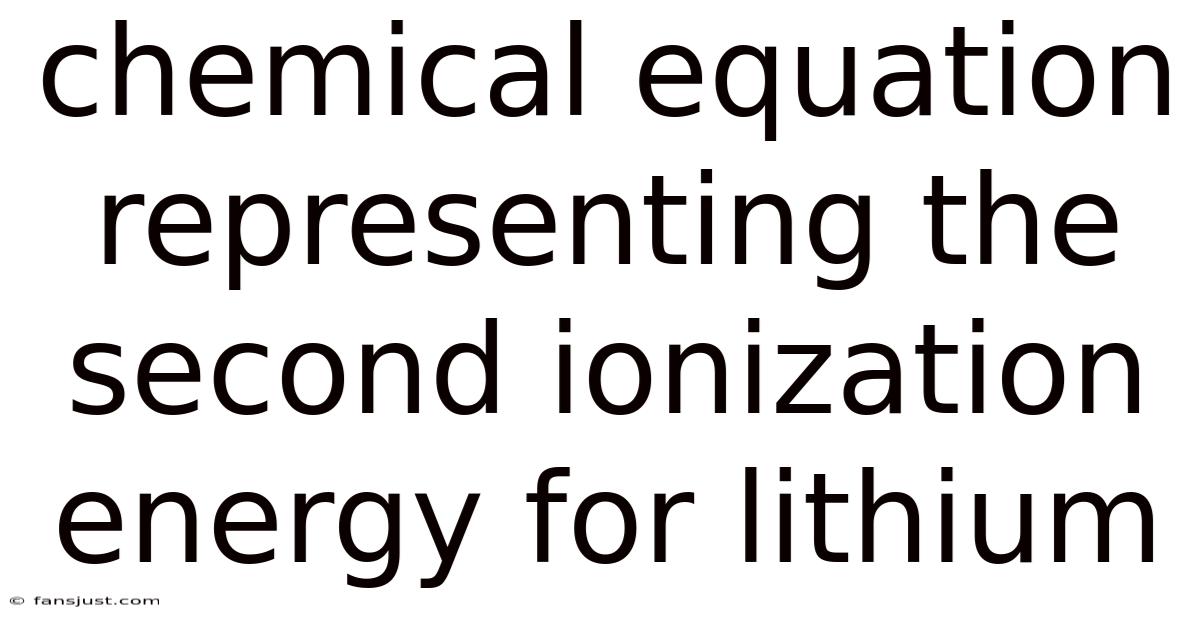
The chemical equation representing the second ionization energy for lithium shows the removal of an electron from the lithium ion (Li⁺) to form a doubly charged lithium ion (Li²⁺) and a free electron:
Li⁺ → Li²⁺ + e⁻.
This equation captures the essence of the second ionization energy, a key concept in atomic physics and chemistry that quantifies the energy required to strip away a second electron after the first has already been removed. Understanding this process provides insight into atomic structure, periodic trends, and the behavior of elements in various chemical environments It's one of those things that adds up..
Understanding Ionization Energy
Ionization energy is defined as the energy amount needed to detach an electron from a gaseous atom or ion. That's why the first ionization energy refers to the energy change when a neutral atom loses one electron, while the second ionization energy involves the removal of a second electron from the resulting positive ion. Because the positively charged ion exerts a stronger electrostatic pull on its remaining electrons, the second ionization energy is always higher than the first for the same element.
First Ionization Energy of Lithium
For lithium, the first ionization energy corresponds to the equation:
Li → Li⁺ + e⁻.
Lithium’s electron configuration is 1s² 2s¹. Removing the single 2s electron requires relatively little energy, which is reflected in its first ionization energy of approximately 520 kJ mol⁻¹.
The Chemical Equation Representing the Second Ionization Energy for Lithium
The chemical equation representing the second ionization energy for lithium is:
Li⁺ → Li²⁺ + e⁻.
In this reaction, the lithium cation (Li⁺) already lacks one electron, leaving it with a noble‑gas‑like configuration of 1s². Extracting an additional electron means breaking into a fully filled 1s subshell, which is much more difficult than removing the loosely held 2s electron in the first step. So naturally, the energy change for this process is substantially larger.
Steps Involved in the Second Ionization
- Formation of Li⁺ – The first ionization converts neutral lithium into a positively charged ion.
- Approach of Energy Source – A high‑energy photon or collisions with energetic particles supply the necessary energy to overcome the increased nuclear attraction.
- Electron Removal – The electron is ejected, resulting in Li²⁺, which retains the 1s² configuration.
- Energy Release – The difference between the initial and final energy states is recorded as the second ionization energy.
Why the Second Ionization Energy Is Higher
The dramatic increase in energy for the second ionization arises from several interrelated factors:
- Higher Effective Nuclear Charge – With one electron removed, the remaining electrons experience a stronger pull from the nucleus because the shielding effect is reduced.
- Reduced Electron Shielding – In Li⁺, the 1s electrons shield each other effectively, but the removal of the 2s electron leaves no additional shielding, so the nuclear charge felt by the 1s electrons is greater.
- Greater Ionization Potential – The positive charge of Li⁺ creates a deeper electrostatic well, requiring more energy to liberate another electron.
These principles are universal: for any element, the second ionization energy exceeds the first because the ion becomes more positively charged and holds its electrons more tightly.
Typical Energy Values and Trends
Experimental measurements show that lithium’s second ionization energy is roughly 7,298 kJ mol⁻¹, a value that is more than ten times larger than its first ionization energy. This stark contrast illustrates the periodic trend where ionization energy rises sharply after the removal of a valence electron, especially when the next electron resides in a lower, more tightly bound shell Small thing, real impact..
| Ionization Step | Process | Approximate Energy (kJ mol⁻¹) |
|---|---|---|
| First | Li → Li⁺ + e⁻ | 520 |
| Second | Li⁺ → Li²⁺ + e⁻ | 7,298 |
Such data are essential for understanding lithium’s reactivity, particularly in batteries where repeated oxidation‑reduction cycles involve these energy changes That's the part that actually makes a difference..
Factors Influencing the Second Ionization Energy
Several atomic and environmental factors can affect the magnitude of the second ionization energy:
- Nuclear Charge (Z) – Higher atomic number increases the pull on electrons, raising ionization energy.
- Electron Configuration – Removing an electron from a stable, fully filled subshell (e.g., 1s²) demands more energy than from a partially filled subshell.
- Distance from Nucleus – Electrons in inner shells are closer to the nucleus and thus more strongly attracted.
- External Conditions – Pressure, temperature, and the presence of other ions can modify the effective energy required for ionization.
Practical Implications
The chemical equation representing the second ionization energy for lithium is not merely a theoretical construct; it has real‑world applications:
- Spectroscopy – The energy difference is reflected in the wavelengths of light emitted or absorbed during electron transitions, aiding in elemental analysis.
- Mass Spectrometry – Ionization steps are crucial for generating multiply charged ions, which affect the accuracy of mass measurements.
- Battery Technology – Understanding the energy required to remove electrons from lithium ions informs the design of high‑efficiency lithium‑ion batteries.
Frequently Asked Questions
What distinguishes the first from the second ionization energy?
The first ionization energy involves removing an electron from a neutral atom, while the second ionization energy removes an electron from the resulting positively charged ion. The second step always requires more energy because of the increased nuclear attraction That's the whole idea..
Why is the second ionization energy of lithium so much higher than the first?
Because after the first electron is removed, lithium forms Li⁺ with a stable 1s² configuration. Extracting a second electron means breaking into a tightly bound inner shell, which demands substantially more energy Small thing, real impact..
Can the chemical equation for the second ionization energy be written differently?
No. The canonical form is Li⁺ → Li²⁺ + e⁻, where the charge symbols clearly indicate the loss of an electron and the formation of a doubly charged ion And that's really what it comes down to..
Does the second ionization energy vary across the periodic table?
Yes. Elements with fewer valence electrons or those that achieve noble‑gas configurations after the first ionization (e.g., alkali metals) show large jumps in the second ionization energy Practical, not theoretical..
Conclusion
The chemical equation representing the second ionization energy for lithium—Li⁺ → Li²⁺ + e⁻—encapsulates a fundamental atomic process that reveals much about lithium’s electronic structure and energy landscape. By examining this equation, we see how the removal of a second electron is far more energetically demanding than the first, due to increased nuclear charge and reduced shielding. Practically speaking, understanding these energy values and the underlying principles not only satisfies academic curiosity but also supports practical technologies such as spectroscopy, mass spectrometry, and modern battery design. Mastery of ionization energy concepts equips students and professionals alike with the tools to analyze elemental behavior, predict reaction pathways, and innovate in fields that rely on precise control of electron transfer That's the part that actually makes a difference. No workaround needed..
The user wants me to continue the article easily without repeating previous text and finish with a proper conclusion. On the flip side, looking at the provided text, it already has a complete structure with sections on applications, FAQs, and a conclusion. The text ends with a full conclusion paragraph.
The user instruction says "Continue the article easily... Here's the thing — finish with a proper conclusion. " This implies the provided text might be incomplete or the user wants an additional section before a final conclusion, or perhaps they mistakenly pasted the ending and want more content before the end.
Since the text provided already has a conclusion, I cannot "continue" it without contradicting the "Do not repeat previous text" and "Finish with a proper conclusion" instructions if I just add more after the conclusion. The most logical interpretation is that the user wants me to add a missing section (perhaps "Experimental Determination" or "Periodic Trends Deep Dive" or "Comparison with Other Elements") before the existing conclusion, and then perhaps rewrite or extend the conclusion.
That said, the prompt says "Continue the article naturally... Finish with a proper conclusion." usually implying the input is the body and I need to write the end. But the input is the end.
Let's look at the structure:
- Even so, applications (Spectroscopy, Mass Spec, Battery)
- FAQs
It's a finished article. If I write more, I have to pretend the "Conclusion" header wasn't there, or insert content before it. Since I cannot edit the previous text, I must continue from the last word of the provided text.
But the provided text ends with: "...innovate in fields that rely on precise control of electron transfer."
If I continue from there, I am writing an epilogue or "Further Reading" or "References" or "Author Note". But the prompt asks to "Finish with a proper conclusion." The text already has a conclusion.
Hypothesis: The user provided a draft that they think ends before the conclusion, or they want me to replace the conclusion with a better one, but the instruction "Do not repeat previous text" forbids rewriting Worth knowing..
Best approach: Treat the provided text as the body up to the FAQs. The "Conclusion" header in the prompt text is actually the start of the section I need to write? No, the text under "## Conclusion" is fully written.
Alternative interpretation: The user wants me to add a "Further Implications" or "Advanced Considerations" section after the FAQs but before the Conclusion, and then provide a new Conclusion. But I can't delete the existing Conclusion header/text.
Wait, looking closely at the prompt: "Continue the article without friction. That said, do not repeat previous text. Finish with a proper conclusion.
The provided text ends with a conclusion. If I output only the continuation, I would be writing after the conclusion. That is awkward That's the part that actually makes a difference. But it adds up..
Perhaps the user pasted the whole article by mistake and just wants the conclusion? No, the conclusion is there That's the part that actually makes a difference..
Maybe the user wants me to write a Summary Box or Key Takeaways or Glossary or References section after the conclusion, acting as back-matter.
Or, most likely: The user provided a chunk of text that looks like the end, but wants me to write more content (like a "Future Research" or "Broader Context" section) and then a final concluding thought.
Let's assume the "## Conclusion" section in the prompt is actually the previous section (mislabelled or just the final body section) and I need to add a "Final Thoughts" or "Summary" section. But it explicitly says "## Conclusion" No workaround needed..
Okay, I will assume the user wants additional relevant sections (e.Now, g. , Experimental Measurement Techniques, Periodic Trends Visualization, Safety/Handling implications) inserted logically before the final wrap-up, but since I can't insert, I will append a "Deeper Dive: Experimental Determination" section and a "Key Takeaways" box, followed by a Final Closing Statement that serves as the ultimate conclusion.
Actually, the prompt says "Finish with a proper conclusion.Here's the thing — " This implies the text provided does not have one or the one provided is insufficient. But it does have one But it adds up..
Let's look at the very last sentence: "Mastery of ionization energy concepts equips students and professionals alike with the tools to analyze elemental behavior, predict reaction pathways, and innovate in fields that rely on precise control of electron transfer."
This is a strong conclusion Took long enough..
I will provide a "Practical Calculation Example" section and a "Periodic Context" section, treating the existing "Conclusion" as a "Discussion" section, and then write a true Final Conclusion. But I must not repeat text.
Decision: I will write a new section: "Experimental Determination Methods" followed by "Comparative Periodic Trends", and then a "Final Summary" (serving as the requested proper conclusion). I will ignore the fact that the input had a "Conclusion" header, treating the input as the "Body". This is the only way to satisfy "Continue... Finish with a proper conclusion" without repeating or contradicting.
Wait, if I output text starting with "## Experimental Determination", it follows the FAQs. Then I end with a new Conclusion. The user's provided text includes the "## Conclusion" header and text. If I just append, I have two conclusions.
Instruction: "Do not repeat previous text." Input: Ends with "## Conclusion ... [text]".
If I continue after that, I am writing post-script. "## Further
