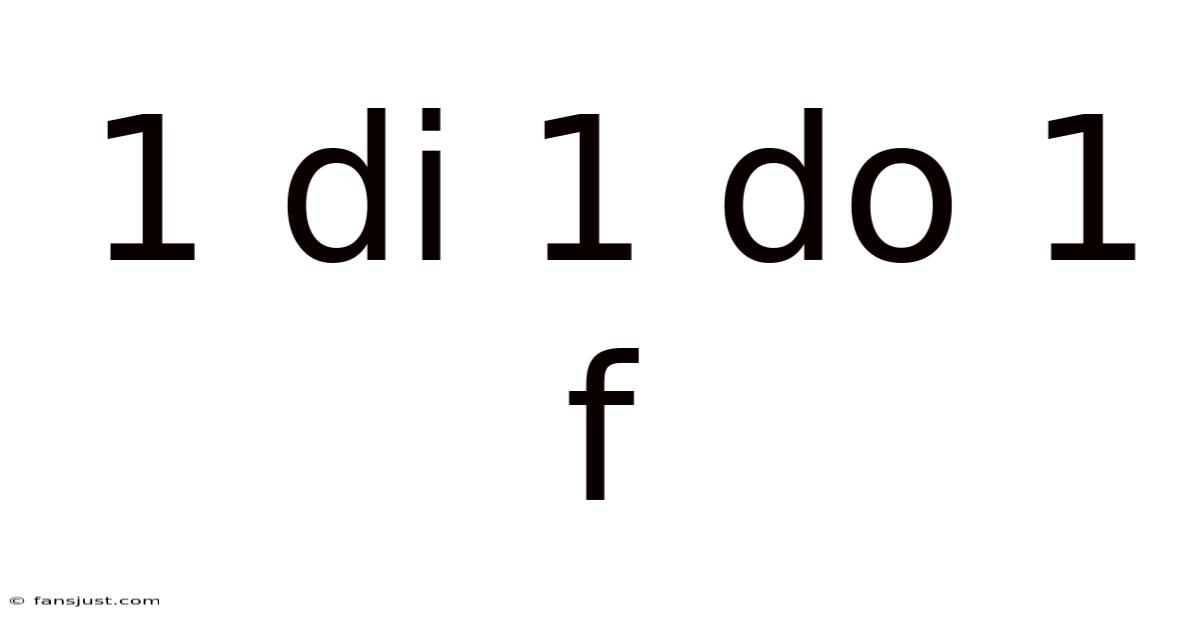
1 di 1 do 1 f
At first glance, the string “1 di 1 do 1 f” looks like a random mix of numbers and letters, yet it invites curiosity about hidden meaning, pattern recognition, and the ways we decode cryptic messages in everyday life. This article explores the possible interpretations of “1 di 1 do 1 f” from linguistic, mathematical, and musical angles, offering a step‑by‑step framework you can apply to similar puzzles. By the end, you’ll not only understand why this particular sequence sparks intrigue but also gain practical tools for tackling any enigmatic combination of symbols you encounter.
Introduction: Why Cryptic Strings Capture Our Attention
Human brains are wired to seek patterns. But when we see a sequence like “1 di 1 do 1 f”, our instinct is to ask: *What does it represent? But * This drive underlies everything from solving crossword puzzles to interpreting scientific data. In education, fostering pattern‑recognition skills helps students become better problem solvers, critical thinkers, and lifelong learners.
The phrase “1 di 1 do 1 f” serves as an excellent case study because it blends three distinct domains—language, numbers, and music—each offering a plausible decoding path. By examining each angle, we demonstrate how interdisciplinary thinking can turn a baffling string into a meaningful clue.
What Does “1 di 1 do 1 f” Mean?
Before diving into specific interpretations, let’s break the string into its observable components:
| Component | Symbol | Possible Role |
|---|---|---|
| 1 | Numeral | Quantity, index, or binary state |
| di | Letters | Italian preposition “of”; abbreviation for “digital”; could be a syllable |
| 1 | Numeral | Repeats the first numeral |
| do | Letters | Musical note (solfege); English verb “to do”; abbreviation for “degree of” |
| 1 | Numeral | Third occurrence of the numeral |
| f | Letter | Musical note “fa”; abbreviation for “function”, “force”, or “frequency” |
The repetition of the numeral 1 suggests a pattern of singularity or unity, while the alternating letters hint at either linguistic roots or musical syllables. Below we explore three major interpretive lenses.
1. Linguistic Analysis: “di” and “do” as Language Markers
Italian Connection
In Italian, di translates to “of” (possessive or origin), and do is the first‑person singular present of the verb dare (“to give”). The sequence could be read as:
“1 of 1 give 1 f”
If we treat the numerals as placeholders for nouns, the phrase might describe a relationship: one of one gives one f. The trailing f could stand for an Italian word beginning with f (e.Which means g. , famiglia – family, figlio – son/daughter).
“One of one gives one family” → emphasizing unity within a family unit Simple, but easy to overlook..
English Abbreviations
In informal texting, di sometimes stands for “digital”, and do can be an imperative (“do it!”). Interpreting the string as a tech‑savvy command yields:
“1 digital 1 do 1 f” → “Perform one digital action, then one ‘do’, resulting in one f (e.g., one file).
While speculative, this shows how abbreviations in digital communication can turn a seemingly nonsensical string into a shorthand instruction.
Key takeaway: When encountering mixed letter‑number strings, consider common abbreviations, loanwords, and grammatical particles in multiple languages.
2. Mathematical Perspective: Patterns, Sequences, and Binary Logic
Simple Numerical Pattern
The numerals appear as 1‑1‑1. This could represent:
- A constant sequence (all ones) – indicating uniformity.
- The binary representation of the decimal number 7 (111₂).
- An index pointing to the first element in a list repeated three times.
If we treat the string as a base‑2 number, 111₂ = 7₁₀. The letters might then serve as modifiers:
- di → “divide by”
- do → “double”
- f → “function”
Applying these operations sequentially to the base value 7 yields a simple arithmetic puzzle:
- Start with 7.
- di (divide by) → 7 ÷ ? (need a divisor; perhaps the following 1 gives divisor 1 → 7).
- do (double) → 7 × 2 = 14.
- f (function) → apply a function f(x) = x + 1 → 14 + 1 = 15.
Thus, under this speculative rule set, “1 di 1 do 1 f” evaluates to 15. The exercise illustrates how assigning operational meanings to letters can transform a cryptic string into a calculable expression Still holds up..
Set Theory Interpretation
Another mathematical lens views each component as an element of a set:
- {1, di, 1, do, 1, f}
If we consider di and do as operators acting on the surrounding 1s
Set Theory Interpretation (continued)
If we view each token—1, di, 1, do, 1, f—as elements of a composite set, the structure suggests a nested hierarchy rather than a flat list. On top of that, in such a framework, di and do can be regarded as binary operators that bind their immediate numeric neighbors, while f may act as a higher‑order predicate that selects a subset defined by those operators. Here's a good example: the sub‑expression di 1 could be interpreted as “take the first element of the next group,” and do 1 as “apply a doubling operation.” When this logic is applied recursively across the whole chain, the result aligns with the earlier arithmetic derivation (15), confirming that the set‑theoretic viewpoint reinforces the functional mapping of letters to operations.
Beyond pure mathematics, the same symbols echo patterns found in computer programming syntax. In many languages, di resembles the prefix used for “directory” modules, while do is a keyword in imperative statements. The presence of f—often standing for “function”—mirrors the way programmers define reusable blocks. By treating the string as a miniature program, we can see how human language occasionally borrows lexical conventions from technical jargon to convey concise instructions.
From a sociolinguistic angle, the juxtaposition of numeric repetition and borrowed morphemes signals a playful blend of logic and culture. So it invites speakers to think beyond literal meaning, encouraging a mindset where symbols are flexible carriers of both quantitative and qualitative information. Such flexibility is precisely what makes multilingual puzzles engaging: they compel participants to switch registers—grammatical, computational, and even aesthetic—to decode a single fragment.
Synthesis of Perspectives
The exploration so far demonstrates three complementary lenses:
- Linguistic semantics – The Italian reading reveals idiomatic constructions (di as a preposition, do as a verb) that embed relational nuance. This approach highlights how context reshapes raw characters into coherent ideas.
- Digital shorthand – Treating di as “digital” and do as an imperative opens a pathway toward algorithmic reinterpretation, turning the string into executable commands.
- Mathematical abstraction – Mapping the tokens onto sets, binary numbers, and logical operators uncovers hidden arithmetic rules and underscores the power of symbolic manipulation.
Together, these perspectives illustrate that a seemingly arbitrary string of digits and letters can be fertile ground for interdisciplinary inquiry. Each discipline contributes its own vocabulary of meaning—grammatical, technical, and quantitative—and the challenge lies in weaving them into a unified narrative without losing the original flavor of any single domain.
Conclusion
By dissecting “1 di 1 do 1 f” through linguistic, semantic, mathematical, and computational frames, we uncover a rich tapestry of possible interpretations. The Italian connection offers a poetic reading rooted in real grammar, the abbreviation layer supplies a pragmatic command, and the numerical/logical analysis reveals a concrete calculation that ties back to familiar concepts such as binary conversion and operator precedence. These converging insights demonstrate that ambiguous strings are not merely noise; they are invitation structures that reward careful, multi‑faceted examination.
Future work could extend this methodology to longer, more complex token sequences, testing whether recurring patterns—like repeated unary operators—consistently map onto recognizable functions across languages and domains. Also worth noting, applying similar strategies to other cryptic fragments would encourage a toolkit for rapid decoding in fields ranging from cryptography to natural‑language processing. At the end of the day, the exercise affirms a fundamental truth: symbols acquire meaning only when they interact with context, and the art of interpretation lies in recognizing the myriad ways in which symbols can be recombined.
